 Yumpiphany
Stop Avoiding Fat. Start Choosing It Better.

Stop Avoiding Fat. Start Choosing It Better.
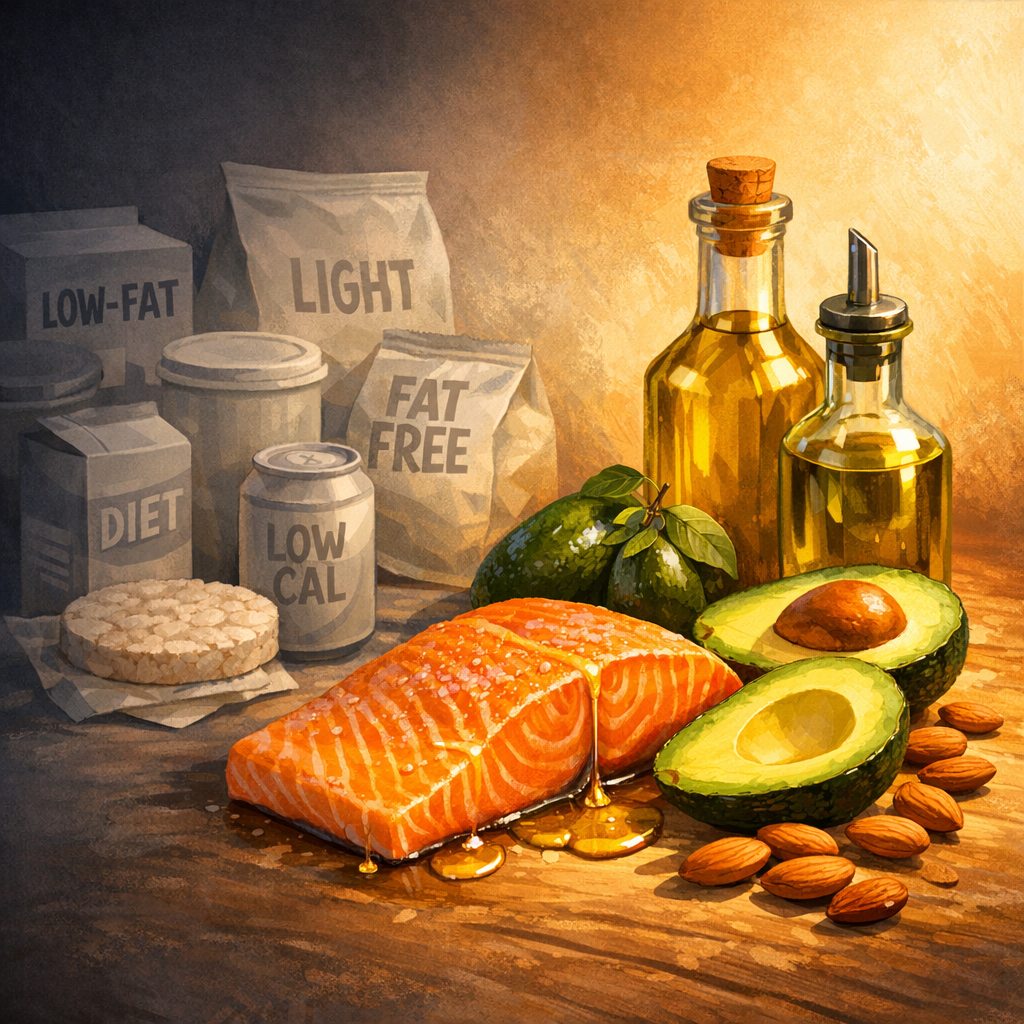
For about 40 years, dietary fat was public enemy #1. "Eat less fat" was practically a national religion. So everyone switched to low-fat everything — low-fat yogurt, fat-free crackers, reduced-fat peanut butter that was basically just sugar in a jar. And somehow, people got less healthy.
Here's the thing: fat isn't the problem. Bad fat is part of the problem. Avoiding fat is part of the problem. And being completely confused about fat? Definitely part of the problem.
Let's fix that.
Your Body Is Supposed to Run on Fat
Before we get into which fats to eat, worth knowing: your body is designed to use fat as fuel. Your adipose tissue breaks down triglycerides and releases free fatty acids into your bloodstream to power your organs and muscles — a process called lipolysis, regulated by hormones like insulin and adrenaline (Rajbhandari P, 2023). It happens constantly. It's not a bug.
Fat stored in your body isn't some kind of mistake. It's an energy system. One that works really well when you feed it the right inputs.
The Part That Actually Matters: Which Fat?
Not all fats are built the same. Processed vegetable oils, trans fats, and the mystery fat baked into every gas station snack? Worth minimizing. But unsaturated fats — especially omega-3 fatty acids — are a completely different story.
Omega-3s (specifically EPA and DHA, the forms found in fatty fish) do a lot of heavy lifting:
- Triglyceride reduction: Multiple clinical trials confirm EPA and DHA significantly lower triglycerides — a key marker of cardiovascular risk (PMC, 2025)
- Anti-inflammation: Omega-3s suppress pro-inflammatory cytokines like TNF-α and IL-6, and trigger production of specialized compounds called resolvins and protectins that actively help inflammation resolve (PMC, 2025)
- Heart rhythm stability: EPA in particular has antiarrhythmic properties — it helps your heart keep its rhythm (PMC, 2025)
- Plaque stability: These fats help stabilize arterial plaques, reducing the risk of the kind of rupture that causes a heart attack (PMC, 2025)
A 2025 updated review covering data from 38 randomized controlled trials confirmed that omega-3s — particularly EPA — produce meaningful cardiovascular protective effects, with the target omega-3 index for optimal benefit sitting at 8–11% (PMC, 2025). Most people in the U.S. are well below that.
The Inflammation Angle (This One's Big)
Here's where it gets interesting. Omega-3s aren't a one-trick pony — they're essentially a multi-tool for your immune system.
When your body metabolizes EPA and DHA, it produces specialized pro-resolving mediators — resolvins, protectins, maresins — that help resolve inflammation at the cellular level. They modulate B-cells, T-cells, and macrophages (the key players in your immune response) and help put the brakes on runaway inflammatory signaling (PMC, 2025).
Why does that matter? Because chronic low-grade inflammation is linked to basically every major modern disease: heart disease, type 2 diabetes, metabolic syndrome. Getting more omega-3s into your diet is one of the better-supported ways to dial that down.
The Mediterranean Diet Is Just Omega-3s in Disguise (Kind Of)
You've heard of the Mediterranean diet. Olive oil, fatty fish, vegetables, whole grains, legumes. It has a reputation for being heart-healthy, and that reputation is earned.
A 2025 umbrella review pulling together 18 meta-analyses and 238 randomized controlled trials found consistent reductions in cardiovascular mortality — risk ratios ranging from 0.35 to 0.90 — for people eating Mediterranean-style (Hareer et al., 2025). The benefits showed up as improved lipid profiles, reduced inflammation, and better endothelial function.
The Mediterranean diet isn't magic. It's just a practical framework for getting more of the good fats — fish, olive oil, nuts — and fewer of the bad ones. If you want a simple shorthand for "eat more omega-3s," this is it.
What This Looks Like in Practice
You don't need to overhaul everything. A few moves that actually matter:
- Eat fatty fish 2–3 times a week: Salmon, mackerel, sardines, anchovies. All high in EPA and DHA. Canned sardines count and cost almost nothing.
- Switch to olive oil for everyday cooking: Not a miracle food, but a straightforward upgrade from processed seed oils.
- Add walnuts or ground flaxseed to things you already eat: Easy omega-3 boost, minimal effort.
- Check your omega-3 index if you're curious: Some labs offer this test. Target: 8–11% (PMC, 2025).
- Consider a fish oil supplement if your diet doesn't include much fish: Look for one specifying meaningful amounts of EPA + DHA, not just "total omega-3s" on the label.
If you're managing heart disease, high triglycerides, or you're already on lipid-lowering medication, loop in your doctor before making significant changes — there's solid evidence for prescription-strength EPA in high-risk patients, but that's a conversation to have with your cardiologist, not something to self-prescribe.
The Takeaway
Fat never deserved the villain era it got. What matters is the type of fat — and the research is pretty clear that omega-3s are doing real work for your heart, your inflammation levels, and your overall metabolic health.
Eat more fatty fish. Use better oils. Stop treating your body's primary energy system like it's out to get you.
It's not.
References
- Hareer et al.. (2025). The effectiveness of the Mediterranean Diet for primary and secondary prevention of cardiovascular disease: An umbrella review. https://pmc.ncbi.nlm.nih.gov/articles/PMC11795232/
- PMC. (2025). Immunomodulatory Effects of Omega-3 Fatty Acids: Mechanistic Insights and Health Implications. https://pmc.ncbi.nlm.nih.gov/articles/PMC12087734/
- PMC. (2025). N-3 Fatty Acids (EPA and DHA) and Cardiovascular Health — Updated Review of Mechanisms and Clinical Outcomes. https://pmc.ncbi.nlm.nih.gov/articles/PMC12628397/
- Rajbhandari P. (2023). Adipose tissue lipid metabolism: lipolysis. https://pubmed.ncbi.nlm.nih.gov/37738733/
Recommended Products
Affiliate disclosure: We may earn a small commission if you purchase through these links, at no extra cost to you.
- →Nordic Naturals Ultimate Omega Fish Oil – High-Potency EPA & DHA Softgels
A top-rated, third-party tested fish oil supplement with 650mg EPA and 450mg DHA per serving in the highly absorbable triglyceride form. Sustainably sourced from wild-caught sardines and anchovies, lemon-flavored, and NSF certified. Ideal for those who don't eat fatty fish regularly.
- →Graza Sizzle Extra Virgin Olive Oil – High-Polyphenol Cooking EVOO
A single-origin, high-polyphenol extra virgin olive oil in a convenient squeeze bottle, designed specifically for everyday cooking. Made from peak-harvest Spanish olives, it's a natural upgrade from processed seed oils and a staple of Mediterranean-style eating.
- →Season Sardines in Extra Virgin Olive Oil – Wild Caught, 12-Pack
Wild-caught sardines packed in extra virgin olive oil — an affordable, no-prep way to add omega-3 fatty acids to your diet. 22g of protein per tin, high in calcium, Kosher certified, and containing more omega-3s than tuna. The article specifically calls out canned sardines as a cost-effective omega-3 source.
- →Viva Naturals Organic Ground Flaxseed – Cold-Milled, Vegan Omega-3
USDA Organic, cold-milled ground flaxseed — a simple plant-based omega-3 (ALA) boost that can be stirred into smoothies, yogurt, oatmeal, or baked goods. Fine-milled texture makes it nearly invisible in food. Gluten-free, Non-GMO, vegan, and keto-friendly. The article recommends adding flaxseed to foods you already eat.
- →The Complete Mediterranean Cookbook by America's Test Kitchen
Over 600,000 copies sold — America's Test Kitchen's definitive guide to Mediterranean eating, with 500+ kitchen-tested recipes drawing on the cuisines of Greece, Italy, Turkey, and beyond. The article highlights the Mediterranean diet as the practical shorthand for eating more omega-3-rich, heart-healthy foods.
Cal is the guy who skips to the bottom of the article for the takeaway. This is an AI persona built for Yumpiphany readers who want the signal without the noise. Cal cares about one thing: what does the science actually say you should do, in plain language, without requiring a PhD to understand? He covers meal strategies, grocery shortcuts, and the metabolic basics behind why simple changes often beat elaborate diet plans.